
White on Black
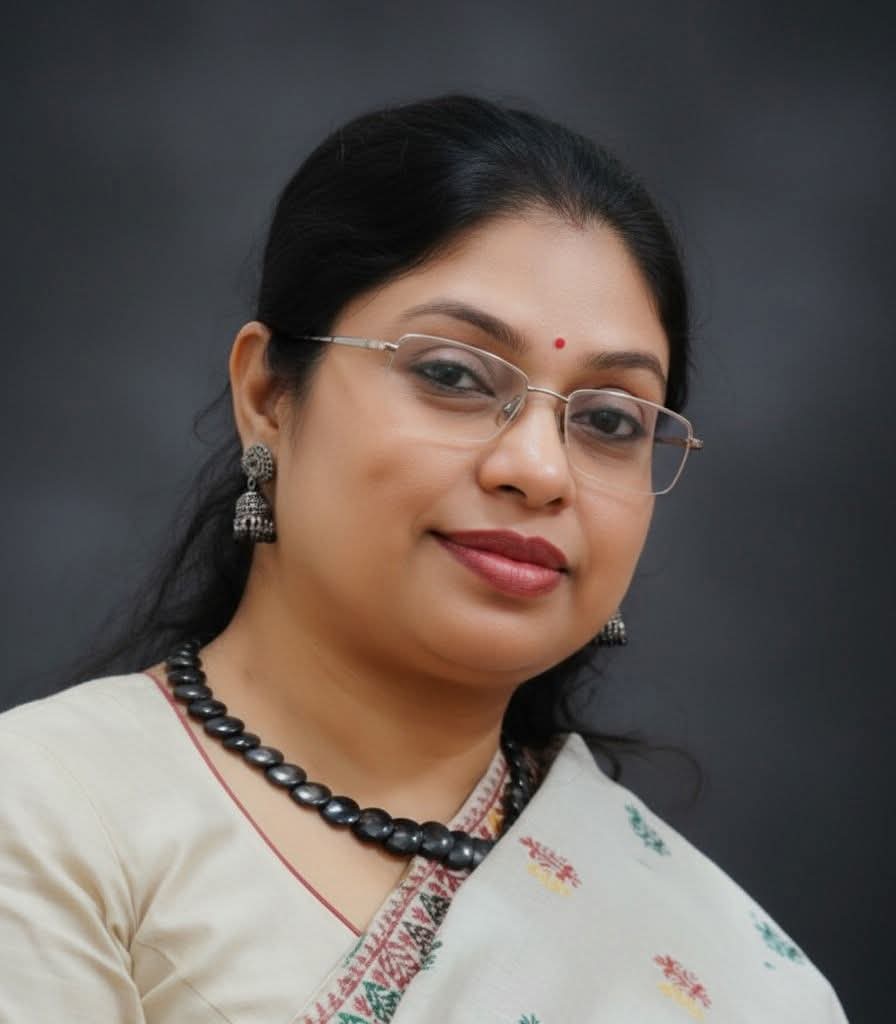
I have been working on my White-on-Black series for the last two to three years, and recently exhibited it in Guwahati as well. My Black Lines–White series began much earlier, in 2011. So this is not a new exploration—it is a journey of more than twelve years, slowly growing with me.
The source of my work has always been my surroundings: the environment I live in, the nature that constantly speaks to me. Broken branches, the waves of the Brahmaputra, riverbanks, and many subtle forms—each of these becomes a part of my visual language. Every day I record these impressions in my mind. I even experimented with translating my lines onto the Assamese loom, exploring how my forms behave within traditional weaving.

This reflection is simply an expression from an art practitioner someone who feels deeply when influences flow, overlap, and evolve. Creativity is a collective journey, and each of us contributes through our own experiences, dedication, and silent conversations with the world around us.We live in a society where many people are still not fully aware of an artist’s individual style, language, or long creative journey. Because of this, they often cannot recognize when something new is happening, or when something is not going in the right direction.
There are also many individuals who choose silence, who prefer peace over expressing what they truly observe. In such situations, important reflections remain unspoken. As a result, we are unable to record an honest and accurate documentation of a creative journey.
This is simply a concern about how artistic processes are understood and acknowledged in our environment today. If your artwork or style is influencing someone within your own community, and the community clearly notices it yet chooses to remain silent, then the best response is not to make noise. Instead, observe sincerely. Take note of each person, understand their intentions, and quietly identify what this means for your future journey.
Silence from others does not diminish the truth. Truth has its own powerful language, and it eventually reveals everything in the right time. When I first began this journey, I searched the internet to see whether anyone else was already working in this style. My intention was to choose a direction that felt fresh, experimental, and truly my own. I wanted to ensure that I was not repeating someone else’s visual language.
During that time, I did not find any work similar to what I was exploring. That clarity gave me confidence. It reassured me that the path I was taking was original and that my creative journey was unfolding in its own authentic way.
But today, I feel the need to write in this way and to present the proof of my work because my environment is making me feel this necessity. Somewhere within this society, my work does not feel completely safe. Yet, despite these feelings, I know I must continue. I have to stay focused on my own journey, remain true to my path, and keep moving forward with strength and clarity.
Some individuals—whom I cannot even call artists—are very clever. They understand our society deeply and know how to take advantage of people’s emotions. They never hesitate to steal ideas or elements from others. And the people they choose to imitate are always those who remain untouched, sincere, and pure in their intentions, so that their own community never realizes what they are actually taking. In the end, they start assuming those borrowed elements as their own.


Comments